
Hello, Grandpa - Review of 'And Every Morning The Way Home Gets Longer and Longer'
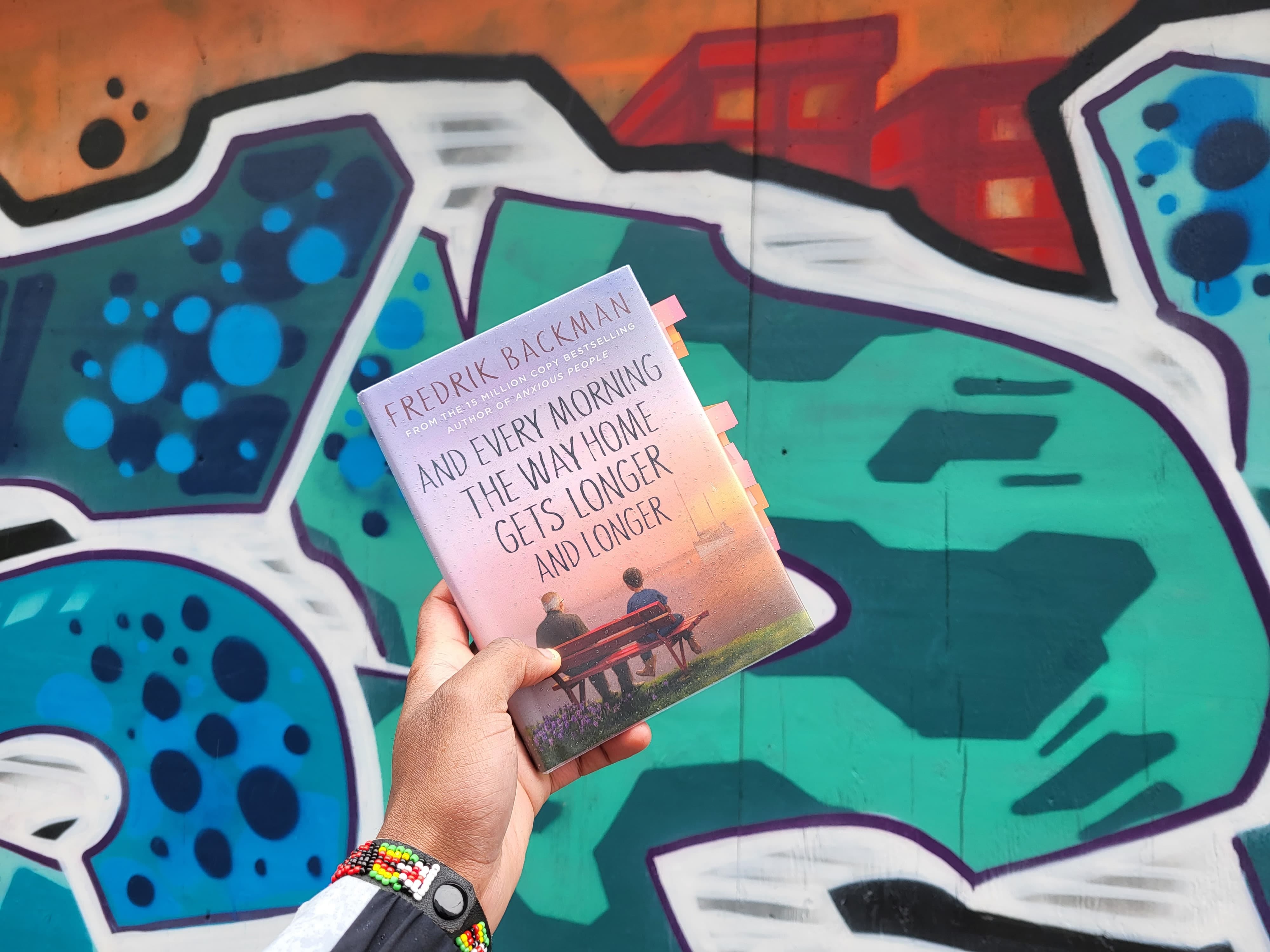
Review of Fredrik Backman's novella 'And Every Morning, The Way Home Gets Longer and Longer'

“When you’ve forgotten a person, do you forget you’ve forgotten?
No, sometimes I remember that I’ve forgotten. That’s the worst kind of forgetting. Like being locked out in a storm. Then I try to force myself to remember harder, so hard that the whole square here shakes”
- pg. 47
After reading Anxious People earlier this year, I made the (easy) decision to read all of Fredrik Backman’s work. Yes, that’s how much I loved the book! Anyway, after powering through A Suitable Boy (the whole 1535 pages of it, phew!), I decided to unwind with And Every Day The Way Home Gets Longer and Longer.
The book is mostly set on a bench within a square that keeps getting smaller as time passes. While the primary characters (if you can call them that) are a grandfather and grandson (Noah), there are also appearances from the (late) grandmother and the father of Noah (Ted). Zoning in on these characters, the novella, explores the relationships among them, how these have changed (and how some have not) - vividly painting (among other things) the regrets and longing that indiscriminately ripple through past, present, and future.
In the preface, which is affectionately framed as a letter to the reader, Backman describes the book as follows:
“This is a story about memories and letting go. It’s a love letter and a slow farewell between a man and his grandson, and between a dad and his boy”
Of course the square is a metaphor, and Backman doesn’t hide this, at least not for long. When you are about seventeen pages in, you are told what the square symbolizes. It is grandpa’s brain and the shrinking is an illustration of his Alzheimer's. So, in a sense, the story narrates how, within this space, he is scrambling to hold on to his memories, but also to prepare himself and his loved ones for the time his brain gives way.
“What do I say to Noah? How do I explain that I’m going to be leaving even before I die?
- pg. 11
In the same preface discussed earlier, Backman points out that he never meant to publish this and as you flick through through the pages, you understand why. Although it is pretty short (around 74 pages), the book is extremely raw. By extending the square imagery, he manages to get us closer to some of our heaviest emotions by blunting them with this abstraction.
Additionally, while underscoring this heaviness, the book also offers a devastatingly moving portrayal of love, loss, and every emotion and memory that shuttles between them. For me, it was impossible to read this without thinking of my own grandfather (and grandmother). Like Noah, my grandfather is quite fond of me, he sees me not only as a reflection of his son, but (apparently) also as someone who will eventually fill his shoes. Also, similar to Noah’s Grandpa, mine also lost his wife, the radiant ball of comfort and mischief that was my grandmother. Because of this, almost every theme felt eerily personal. For example, when the book illustrates the faith his grandfather has in him;
“… Grandpa whispers open your eyes and gives Noah a map and a campus and the task of working out how they’re going to get home. Grandpa knows he’ll manage, because there are two things in life in which Grandpa’s faith is unwavering: mathematics and his grandson”
- pg. 2
It reminded me so much of my old man. Together with my grandma, they had a blind and wreckless faith in me. In Tailora, I mentioned how this was particularly pronounced in my grandmother. She loved me in ways that I honestly often fail to comprehend. It was something like this conversation between Noah and his own grandmother;
“The amount I love you, Noah, she would tell him with her lips to his ear after she read fairytales about elves and he was just about to fall asleep, the sky will never be that big.”
-pg. 33
The tear-jerking bit is when Noah’s grandfather describes how much he loved his wife, how a lifetime with her felt like the blink of an eye, how she was both the shortest way home and home itself.
“Her hair is old but the wind in it is new, he still remembers what it felt like to fall in love; that’s the last memory to abandon him. Falling in love with her meant having no room in his own body. That was why he danced.
We had too little time, he says
She shakes her head.
We had an eternity. Children and grandchildren.
I only had you for the blink of an eye, he says.
You had me for an entire lifetime. All of mine.
That wasn’t enough.
She kisses his wrist; her chin rests in his fingers”
- pg. 9
“I miss you unbearably.
She smiles, her tears on his face.
Darling stubborn you. I know you never believed in life after death. But you should know that I am dearly, dearly, dearly hoping that you’re wrong”
- pg. 45
This reminded me of how this person that he (my Grandfather) had known for longer than I was alive, longer than my father was even an idea, was no longer with him. How his whole world had been revolving around her, and he had lost that. He somehow had to adjust to this stillness. To his love disappearing into nothingness. Death isn’t fair.
“I always knew who I was with you. You were my shortcut, Grandpa confides.
Even though I never had any sense of direction. She laughs
Death isn’t fair
No, death is a slow drum. It counts every beat. We can’t haggle with it for more time.”
- pg. 54
Again, I recalled how ridiculous time is. How every second that passes is sand trickling down in the hourglass of the moments we can share with our loved one.
“When his dad picked him up from Grandma and Grandpa’s in the evenings he wasn’t even allowed to say those words to her. Don’t say it Noah, don’t you dare say it to me! I get old when you leave me. Every wrinkle on my face is a good-bye from you, she used to complain. And, so he sang to her instead and that made her laugh.” - pg. 32
Or how time is more circular than we think it is. How the beginning and the end blur into each other. How much we take for granted our ability to connect with our past in its entirety - the love, the joy, the loss, the pain, our whole existence. How precious these parts of ourselves (cushioned between memories) are.
“His grandpa is next to him and is incredibly old, of course, so old now that people have given up and no longer nag him to start acting like an adult. So old that it’s too late to grow up. It’s not so bad either, that age.” - pg. 1
Overall, the book was so good, it makes a mockery of anything I considered ‘raw’ or ‘moving’ before this. While I would recommend this to anyone, especially those that have lost (or are losing) someone, I would say have some tissue or handkerchief to dab some stray tears. Until next time!


